Bob Dylan’s hit song The Times They Are A-Changin' supposedly signalled the dramatic changes destined for our social order:
The order is rapidly fadin' And the first one now Will later be last For the times they are a-changin'
But progress is not a zero sum game. And further, if you asked Dylan who was first and who was last all these years later, the answer wouldn’t be so clear.
Tech zealots also believe that the times are changing. The old ways of our world no longer apply. AI and its derivatives bring about dramatic new changes to our technical order.
You won’t write the code.
You won’t review the code.
You won’t read the code.
Eventually you won’t understand need to understand any of it!
You’ll babysit a small army of coding agents who will do everything for you! The systems will run themselves! It’s going to be so amazing! We just need to tear this place down to the studs…no, the foundation…no, the earth!
Only once we start over can we make this vision reality. It’s like Chesterson’s fence. The bleeding edge is slowed by the core principles of our industry, and rather inquire about their continued utility, they seek to remove them entirely.
And in some cases, tearing down the fence may be net good! I think that if they stepped back, the zealots would find that their forebears found clever ways of starting new. They were just quiet about it.
Thinking about having an LLM “write for me” triggers my gag reflex. Every day I get several obviously LLM-written emails from “fans” or “readers” “pitching” me on their new product or essay or book. But how can I trust a person who can’t even write an email? Those emails get deleted immediately. LLM writing has its place (usually in transactional correspondence where humanity is irrelevant). But its place is not in essays, books, or personal emails. If an LLM can write your book or essay, then it’s not the book or essay you should be writing.
I wish I had the luxury of ignoring the synthetic words of my colleagues. In theory, I could, and I’m sure my colleagues wouldn’t actually mind (or notice). They’d be perfectly fine with delegating their agency to an LLM, and live in bliss, unencumbered by a grump who cares.
And it’s for that reason that I feel compelled to respond, to dig in to their long and ill-considered tomes. So I cannot just give a thumbs up (or a LGTM) or worse, ignore these messages outright. I get paid to care, and I have my vocation in some part because I care.
A few months ago, someone complained to me that the new (very hot stuff) startup they were at had a “lgtm culture.” Upon inquiry, they explained that no matter what they do or how good it is, everyone just says “looks good to me.” “I know I should feel good about being a competent, trusted, contributing team member,” he continued, “and my new colleagues are so, so kind, but at the end of the day I just feel like no one has any standards.” He looked down at his coffee for a moment. “I’m afraid I’m never going to see my best work again.”
That last line encapsulates how so many folks are feeling. Despite having the power of all-knowing, fast-working robots at the tips of our fingers, it seems harder to do big, important work than ever.
Between the meetings and the messages and the hedonic treadmill of tools, there’s no time for people to come together and accomplish grand feats of technology. Everyone yearns for the small pockets in their day to breathe and push along the smallest tasks to keep their interests moving.
They go with the flow, and maintain status quo, because that means that they can keep playing their single player game for a quarter more.
LLMs make this charade automatic. But if it all becomes fake work, then it’s not really your vocation, is it?
My riff in it for software is “if you’re so smart, then why don’t you ship?”
Most teams in software think they’re above standards SDLC practice. They’ll adopt the easy stuff (sprints, ceremonies, etc), but make bizarre changes to “suit the needs of the team”. Just today, a principal engineer suggested 4 week sprints, with the first week reserved for planning. This, he says, is perfect for us, because it gives us the space to figure out what we’re doing.
This is supposed to help us reliably commit to work and deliver it on time. No other changes to how we intake projects or refine them or decompose them or assign them. We‘ll just tweak a couple of variables. Compress all the refinement into one week, and tack an extra week into the working time.
I’m a scrum purist. Or a Shape Up purist. Hell, I’d even get behind waterfall if we followed the methodology to a T. I think I’m pretty smart, but I’ve learned that I’m not smarter than a coherent SDLC methodology. Your company is not going to win because you have a novel way of delivering software.
The best teams I’ve worked with live and die by the book. Except that they don’t die, they just reliably deliver high quality software, then go home to live in bliss, because they didn’t spend all day trying to untangle whatever mess their newfangled project management system got them into.
Like every other team that does this, we’ll try it out for a couple of months, realize it isn’t working, and chalk it up to “learning as we go”. But god forbid someone suggest that we just follow the handbook. That’s just not going to work for us. We’re different. Our team is special.
To which I say, “if we’re so smart, why aren’t we happy?”
August 11, 2026
Grok Bot dropped today and it’s a bright spot in my otherwise pessimistic AI outlook of late. It’s the first love child of the Cursor and SpaceXAI merger (it really is a merger, even though it’s technically an acquisition). It feels just like Cursor, and has the personality of new X (Benji Taylor’s fingerprints are everywhere).
Just a month ago, commenting on Cursor’s new side chats feature, I tweeted:
Once Cursor builds a harness for general purpose knowledge work, everyone else is fuckin toast. They’re the only AI company with a cohesive product, and over the next couple they’ll start lapping the competition.
I wasn’t expecting to see it happen quite this soon, but I’m not at all surprised it’s been executed so well. I’ve been using Cursor as my daily driver for the last 2 years, with Composer (and lately Grok) as my main models. That combo hits the sweet spot of smart, speedy, and pleasant to deal with. Cursor’s harness is really great, doesn’t require any skills to be effective, and lately has made great use of subagents.
Grok Bot feels exactly the same in my initial use. I created my first agent by asking Grok about to build me a fleet of agents:
Help me create a fleet of agents that can help me launch and grow a product design agency that helps seed to series B b2b SaaS companies improve their onboarding and activation. I follow a lot of what Alex hormozi has to say about offers, and also what Daniel fazio of client ascension has said about ai assisted agencies.
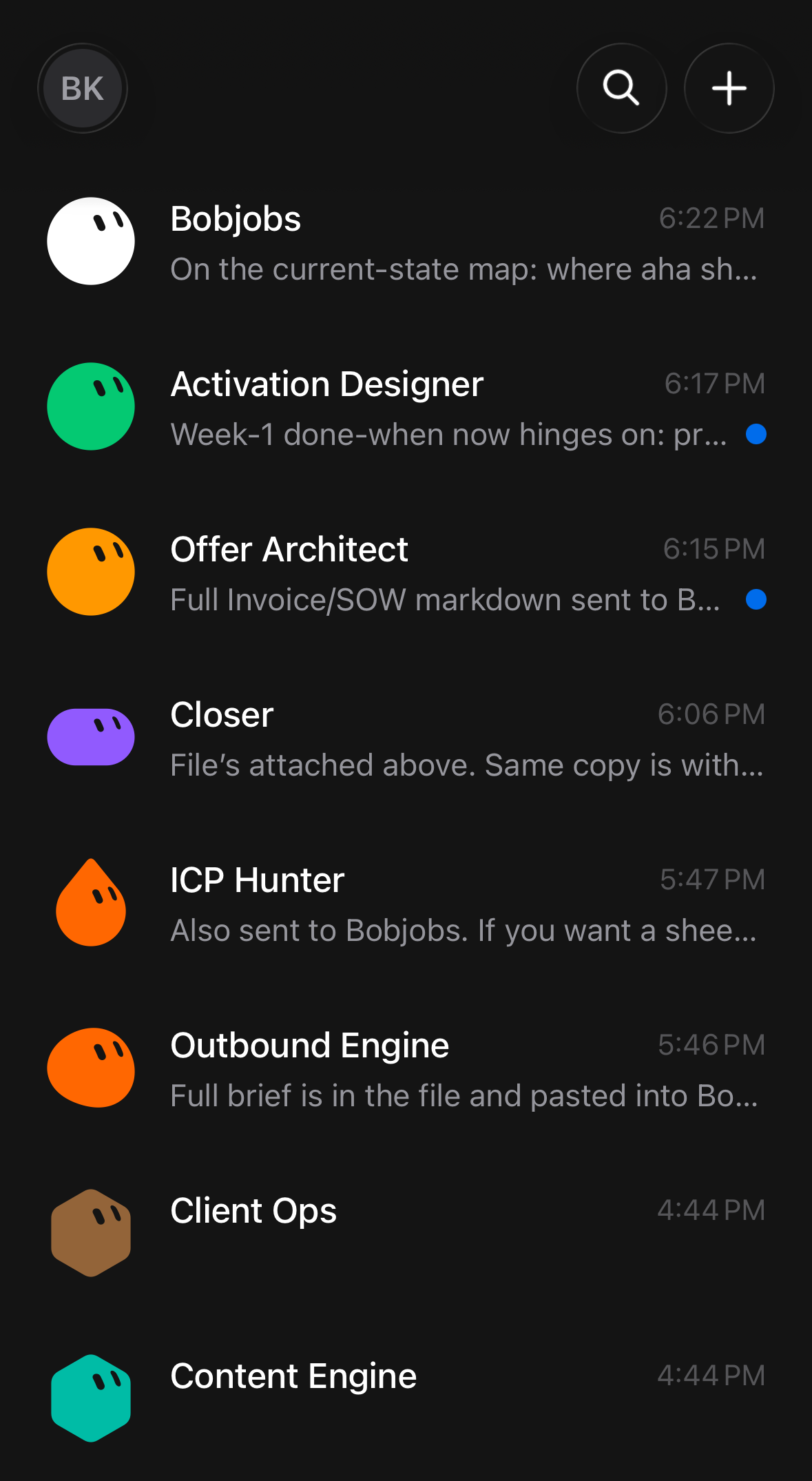
Bobjobs understood the assignment, and spun up 7 additional agents to put under his command.
The main agent then helped me “launch” my agency by summoning the specialist agents to build offers, research my ICP, create lead lists, and more. The handoff is relatively seamless, the main agent will delegate a task, continue doing its own work, and wait for the other agent to report back.
Like in Cursor, you’ll frequently be presented with multiple choice questions to keep the agents on track. They’ll calmly do what they’re asked, and spit out documents as they go to give you durable artifacts of their work.
A distinguishing feature between Grok Bot and every other AI tool I’ve used is that your work with the agents feels durable. Rather than turn-based chats about a single topic, Grok Bot is meant to behave like iMessage or Slack. Conversations are continuous, and not meant to be thrown away when you’ve reached a conclusion.
Agents truly act as coworkers. You can tag them in and out as you need, or spin up new group chats to work together on something specific.
None of this is earth shattering. Some folks have been developing patterns like this over the course of the year. But Grok Bot is the first time I’ve seen this tech put into a polished product that feels like more than a demo.
I’m really, really excited to see what the Cursor and X teams are able to build together. Both companies feel collaborative, and give an MMORPG vibe. Claude and OpenAI, in contrast, very much feel like thousands upon thousands of single player games being played simultaneously.
To Americans, this comes out of left field. I find it fascinating that Dario was adamant to push back against the US government earlier this year, but gives into the EU without much fanfare. I’m sure activist groups on this side of the pond will pick up on this headline and push for similar regulations here.
Anthropic says that all text and graphics generated by Claude will include these watermarks, but doesn’t call out code one way or another. That will be a very slippery slope, because they could be laying the groundwork for accepting liability when the LLM’s code wreaks havoc down the line.
To me, liability is going to be the biggest roadblock to widespread agentic AI. Our world depends on having wringable necks to take responsibility when things go awry. When you remove humans from the loop, you also remove the easy placement of blame.
I doubt that Anthropic counsel and shareholders will allow the company to hold the bag, and this move to attach provenance to Claude’s output gets them one step closer to some very uncomfortable situations.
August 9, 2026
Every so often, I stumble upon an interesting book in Amazon's recommendations that I've never seen.
Yesterday, it was Articulating Design Decisions by Tom Greever. I would've normally (and likely have previously) scrolled right past it, because on the surface, it sounds pedestrian.
But lately, I'm finding myself having to articulate my design decisions! In the last quarter, our company lost the PM that I've worked with for over 3 years, and also the CTO who'd sponsored our big project. You forget how luxurious familiarity can be until you find yourself surrounded by strangers, trying to work without the faith that once empowered you to move without resistance.
Last week, I was caught off guard by reasonable questions about my work, and felt embarassed that I wasn't prepared with a good response. All the context is gone, the relationships lacking, and my confidence is disappearing. So a book about articulating is serendipitous.
Most of the book throws red flags, as it's written in the spirit of How to Win Friends and Influence People and Seven Habits of Highly Effective People. I'm allergic to people-pleasing, and this book points out that a successful designer is often the most agreeable one. It also suggests that the way to articulate choices is by having lots and lots and lots of meetings.
I almost put the book down, until I realized that there are two types of designers:
Designers that take orders
Designers that make magic
Most designers are the former. They'll provide a menu, but are happy to allow stakeholders to customize their orders.
But the best designers, the ones that make magic, are omakase designers. Somehow, some way, they gain the trust of stakeholders so much that they're able to do whatever they want, and the stakeholders excitedly eat it up, no matter what. The most celebrated products are made by omakase designers, who are have a vision and the leash to make it reality.
Just how does a designer get that leash? What do they do that gains them so much trust from the people footing the bill?
It's not because they have a better pedigree or are more talented or have better ideas.
It's because they communicate precisely why their solution is not just the right solution to a problem, but the only solution. They know that the place they landed is inevitable, and pull the rest of the team along in such a way that they know it too.
Here are 5 key traits of the omakase designer:
They're aware of the problem that needs to be solved
They know how a solution will be deemed successful
They are aware of each choice, big and small, that they made inside their process
They're able to explain why they made each choice in the process
They document all of the above in a way that makes the points above visible
Everything else is finesse. You can be a flaming asshole or a hack of a designer and still be successful if you're able to communicate why your solution is the best one available. The author tries to convince the reader that all the intangible skills are imperative, but they're secondary to your ability to bring your audience along for the ride.
August 8, 2026
The world wants you to be Kroger. Be Jungle Jim.
August 7, 2026
If you Google “through of disillusionment” you’ll find a bunch of premature articles from 2024 and 2025 talking about how AI is in the low point of the current hype cycle.
Summer of 2026 will go down as the real trough, and January 2026 will be remembered as the peak. The tech didn’t get good enough until late 2025, and it took the holiday downtime for people to realize how powerful it had become.
Leaders spent Q1 trying to mandate agentic workflows, and by Q3 they realized that they blew through the year’s budget with little to show.
Come September, when everyone’s back from Summer, there’s a lot of sobering up to be done. Startups that raised on insane valuations will have to face the economic realities of their business. Established players will shift focus from agents back into their core line of business.
By early 2027, the industry will restructure around these realities, and sanity will return.
All products with strong brand recognition that have gotten lost after the ZIRP grow-at-all-cost era. Each fits squarely into a SMB segment that's willing to pay (but not pay big) for software that does what it says on the tin.
These are all "finished products" that can be shaped up, then put in KTLO mode as steady profit machines. All you'd need to to is create the appropriate unit economics and make sure the brand stays visible when people enter buying scenarios.
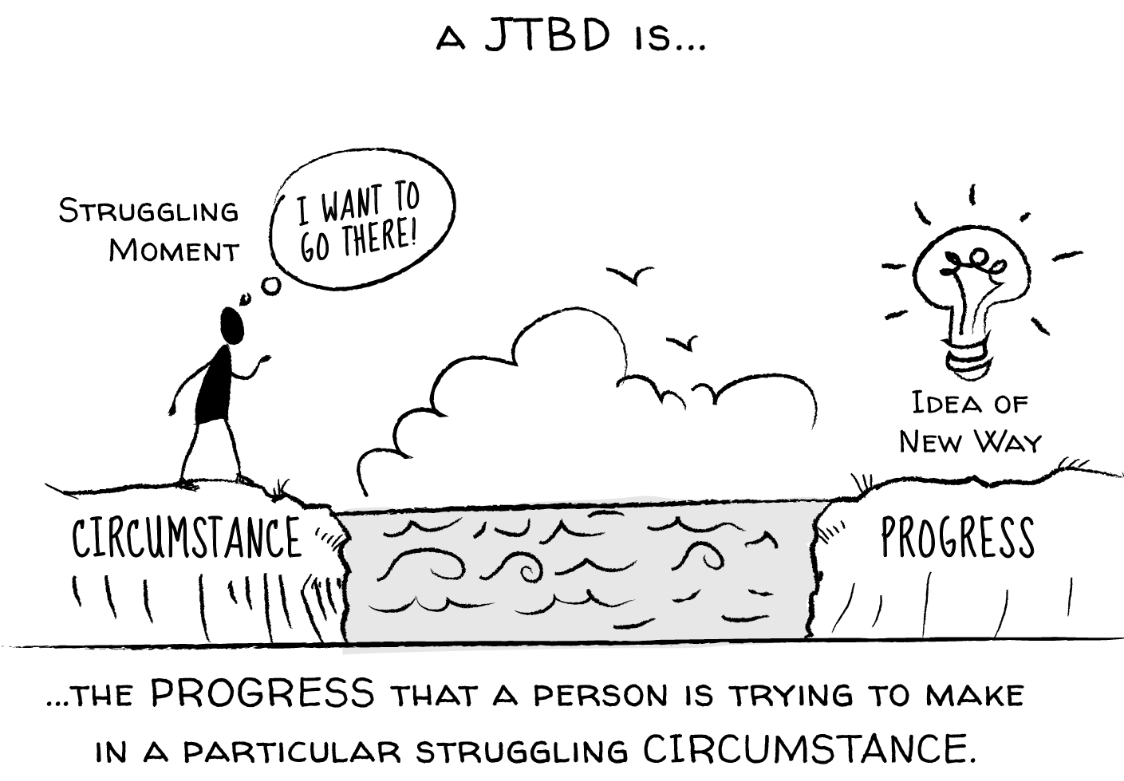
This cartoon from Bob Moesta’s Demand-side Sales 101 is the perfect summary of jobs-to-be-done thinking.
A JTBD is the progress that a person is trying to make in a particular struggling circumstance.
It’s our job as producers to get them from point A to point B in the fastest way or the cheapest way or the most comfortable way, but in the way that best suits the consumer’s current condition.